AI visibility checker: is your brand in the short list?
An AI visibility checker asks the questions your buyers ask, then records what the assistant answered and which sources it cited. The free check returns 3 answers in one run. The $850 diagnostic samples ten questions three times over three days — 30 dated answers, delivered within five business days.
Free AI visibility checker
Three questions · one run each · no signup
The free check returns 3 answers and costs $0; the paid diagnostic adds the source audit and the day-60 re-run.
One answer is an anecdote. Three answers show a range.
AI answers move between runs. A brand can be absent at 9am and second at 2pm without anyone changing a page. A single check is a screenshot; a diagnostic is a series.
We run every question three times and report the runs, not a smoothed number that hides the disagreement.
The spread across three runs is more informative than a single screenshot.
Synthetic example. The point is the spread, not the brand. The free check gives you one run per question; the diagnostic gives you three.
What the $850 diagnostic actually contains.
Ten questions your buyers ask, thirty dated answers, and the reading that turns them into a plan. Delivered within five business days of kickoff. The report is built to be forwarded, not logged into. The report runs to 8 pages, with the 30 dated answers and the source audit behind the finding.
Ten buying questions
Chosen with you, in the language your buyers use, not a generic prompt list.
Thirty dated answers
Three logged-out runs per question over three days. Every answer kept, including the ones that disagree.
Competitor position
Mention and recommendation rates against three named competitors, with the questions where they appear and you do not.
Source audit
Every citation classified: directories, communities, editorial, first-party, video. What the answers read, and what they ignored.
Three actions
Prioritised by effort and evidence, each with a success measure and the page or profile that owns it.
Day-60 re-run
The same question set, re-run after the work. A before/after page that shows what moved and what did not.
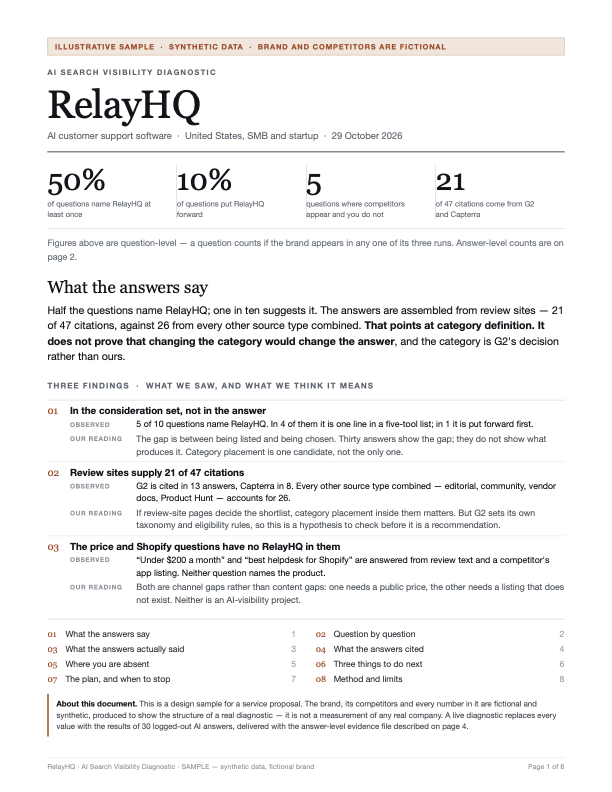
A document you can forward, not a dashboard you have to interpret.
Eight pages, dated, with the answer-level workbook behind it. The first page is the finding; page 4 is the evidence table; page 8 is the method and limits. No login, no seat, no export button to hunt for.
The sample is synthetic and says so on every page. The structure, the evidence table and the limits are the real deliverable.
Open the 8-page sampleThe method is the product.
A tracker samples a synthetic panel and gives you a number. We sample logged-out answers, keep the dates, and read them by hand. The reading is what you are buying.
A hand-read sample is slower than a dashboard and more useful, because it keeps the disagreement between answers.
Every claim in the report traces to a dated answer and the sources that answer cited. If the answer changed between runs, you see both.
That AI answers are stable. That a single “ranking” exists. That a citation proves a claim. That any of this is guaranteed.
Answers vary by session, location and model. We show the variance instead of hiding it.
Pick the questions
Thirty minutes with you. Ten questions your buyers actually ask, plus the three competitors you lose to.
Sample, logged out
Three runs per question over three days, one location, no account history. Thirty dated answers.
Read and classify
Every mention, recommendation and citation is logged. Variance stays visible; we do not average it away.
Walk through, then re-run
A 60-minute walkthrough, three actions, a day-30 execution check and a day-60 re-run.
Two ways to buy. One baseline.
Start with the diagnostic. Monitoring only makes sense after a baseline, because a trend without a starting point is just another screenshot.
The report is invoiced before kickoff. Monitoring is month-to-month, with 30 days' notice. No annual lock-in.
| Deliverable | Diagnostic | Monitoring |
|---|---|---|
| Buying questionsChosen with you | 10 | Same set |
| Dated answersLogged out, three runs each | 30 | Weekly |
| CompetitorsNamed in the report | 3 | 2 brands |
| Source auditCitations classified | Included | Monthly |
| ReportPDF + evidence workbook | 8 pages | Change log |
| WalkthroughLive review | 60 min | 30 min / month |
| Re-runSame questions | Day 60 | Weekly |
| Price | $850 one-time | $350 / month |
| Terms | Invoiced before kickoff | 30 days' notice |
Both include one revision round. New brands or question sets are quoted separately. Monitoring is only offered after a diagnostic.
Tell us the category and the three competitors you lose to.
We reply within 1 business day with whether the diagnostic is a fit. If it is not, we will say so and point you at the free sample.
No newsletter. No sequence. One reply from a person.
What we keep when you use the check or the form.
These are the retention periods in the code, not a generic policy. The privacy page names the processors; methodology lists the data files and the sampling steps, and the 45-answer variance pilot publishes the raw CSV behind its numbers.
Free check: the three answers and their citations are returned to your browser and are not stored by us. Aggregate event counters (for example, “check started”) are kept for up to 120 days. A short-lived in-memory counter rate-limits repeat checks by IP address.
Contact form and result email: the email, brand, website and note you submit, plus the score, source, timestamp and user agent, are stored securely and deleted automatically after 180 days.
Not stored: answer text, a newsletter list, or anything beyond the fields listed above. Read the full privacy page →
Questions worth asking before you buy.
These 5 answers cover the objections that come up before a $850 diagnostic.
Is this just a ChatGPT rank tracker?
No. There is no stable “rank” across logged-out AI sessions. We sample the answers, keep the dates, and report mention rate, position in the answer, cited sources and variance. The free check uses Perplexity Sonar as a fast web-grounded proxy; the paid diagnostic uses logged-out ChatGPT sessions and can add a second surface when scoped.
Why three runs per question?
One answer is an anecdote. Three dated runs show whether a brand is consistently absent, consistently present, or moving between runs. The diagnostic reports the spread rather than hiding it behind one average.
Can you guarantee we will be cited?
No. We can show what the answers currently say, which sources they cite, and the work most likely to change the inputs. We cannot control a model's answer, and we will not promise a ranking or a citation.
How long does the diagnostic take?
The report is delivered within five business days of the kickoff call. The day-30 execution check and day-60 re-run are included. Monitoring, if you continue, is weekly after that.
Is the sample report a real client?
No. The sample is labelled synthetic on every page. RelayHQ is a fictional company; the structure, evidence table and limits are real. We do not show a client logo or result until a client has approved one.